Military Order Targets Three Towns
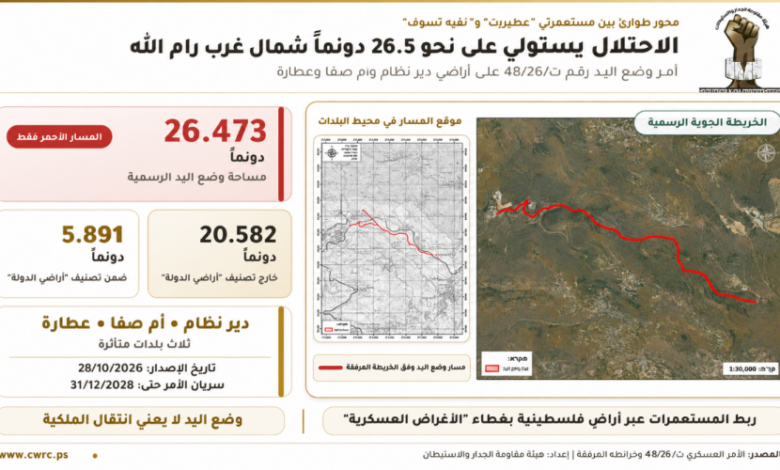
Israeli authorities have issued a military directive ordering the seizure of 26.473 dunams of land located in the villages of Deir Nizam, Umm Safa, and Atara, situated northwest of Ramallah. The order, designated as (T/48/26), was issued on October 28 and remains valid until the end of 2028. According to the Anti-Wall and Settlement Resistance Committee, the directive grants the military commander exclusive possession of the specified lands, effectively placing a strip of territory under military control to serve the connection between nearby settlements.
Land Classification and Strategic Purpose
The seized area comprises 5.891 dunams classified by Israeli authorities as “state land,” accounting for approximately 22.3 percent of the total area. The remaining 20.582 dunams fall outside this classification. The committee noted that this distribution demonstrates the integrated use of land categorization tools and military seizure orders to secure land for settlement infrastructure. By including both state-classified and non-state-classified lands within a single pathway, the measures aim to link settlements and their extensions.
Impact on Local Residents and Settlement Expansion
The significance of the project extends beyond the immediate land area, as it is intended to enhance the connectivity network between settlements, outposts, and expansions surrounding the Atira and Halamish settlements, also known as Neve Tzof. This infrastructure is expected to facilitate the movement of settlers and strengthen their presence among Palestinian villages. Additionally, implementation arrangements may impose further restrictions on landowners’ access to adjacent plots.
Legal Implications and Long-term Control
While the military order regulates possession and seizure for a fixed period without transferring ownership of the land itself, the committee raised fundamental questions regarding the utilization of military powers to cement settlement infrastructure and expand its sphere of control. The directive serves as a mechanism to solidify the physical presence of settlements through temporary administrative measures, raising concerns about the long-term implications for land rights and territorial continuity in the region.