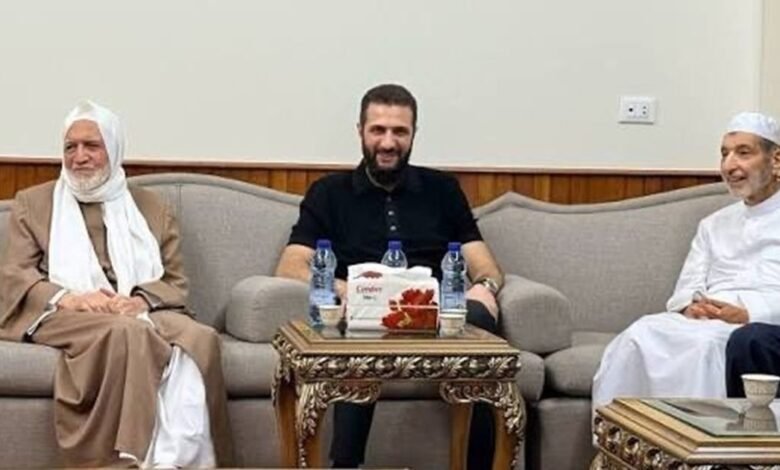
A video recording featuring Syria’s Grand Mufti, Sheikh Osama al-Rifai, has triggered widespread controversy following its circulation over the past two days. In the footage, which sources indicate dates back to a previous period, al-Rifai discusses historical tensions with President Ahmed al-Shara and his associates. He stated that in earlier stages, the group adhered to what he described as “Wahhabism,” reaching levels of “extremism and takfir” (excommunication). However, al-Rifai noted a subsequent shift in their discourse and the emergence of a phase of understanding between the parties.
According to the recording, al-Rifai initially refused to meet with al-Shara and his circle for years before the relationship evolved. He claimed that al-Shara later informed him that he had abandoned extremism and “Wahhabism,” aligning instead with “Ahl al-Sunnah wa al-Jama’ah and the Ash’aris.” Al-Rifai highlighted that al-Shara requested a meeting, leading to an agreement on several religious issues. He asserted that the President and the “majority of his group” were now “fully aligned” with them on religious and scientific matters, no longer clinging to what he termed partial issues, a reference likely directed at the leadership of Hayat Tahrir al-Sham.
The recording provoked significant anger and discussion on social media platforms. Ibrahim al-Hasson, Dean of the Higher Institute of Judiciary in Syria, posted a message praising Muhammad ibn Abd al-Wahhab as a “reviving Imam” whose call confronted innovations and superstitions. Al-Hasson also commended Saudi Arabia’s service to the Two Holy Mosques and its support for Syrians. Meanwhile, Quteiba Ahmad Badawi, Head of the Borders and Customs Authority, emphasized Damascus as the “abode of the Salafi methodology” and stressed that responsibility requires unifying Syrians rather than reducing sacrifices to sectarian classifications.
Syrian journalist Abdul Malek Aboud provided clarifications, stating the meeting occurred approximately two years ago when al-Rifai first returned to Syria. He explained that al-Rifai’s comments reflected concerns from Islamic delegations, particularly those from East Asia leaning toward Ash’ari-Sufi schools, who feared rising extremist influence. Aboud noted that al-Rifai denied these fears, affirming that the new government’s religious path is moderate and based on the four Sunni schools. This dialogue preceded the signing of the “Charter for Unity of Islamic Discourse in Syria,” which aimed to unify religious speech and reject sectarian differences.
President al-Shara appointed al-Rifai as Grand Mufti on March 28, 2025, establishing the Higher Council of Fatwa under his presidency. Al-Shara stated this move was part of rebuilding state institutions to ensure moderate religious discourse and unify fatwa authority. The controversy underscores ongoing efforts to stabilize Syria’s religious landscape amidst complex historical narratives and political transitions.