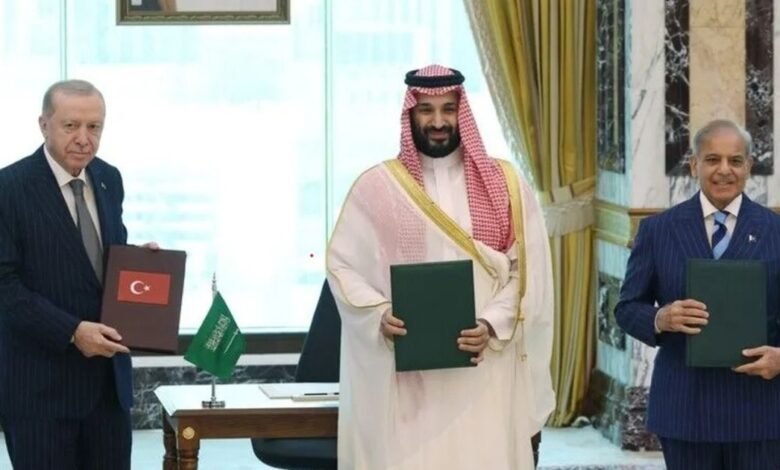
The Official Gazette of Turkey confirmed on Friday that President Recep Tayyip Erdogan has formally approved the Mecca Agreement for joint defense involving Saudi Arabia and Pakistan. This ratification completes the legislative process in Ankara, following the Turkish Parliament’s approval of the pact earlier this month. The agreement was originally signed in Mecca in August amidst escalating concerns regarding the US-Israeli war against Iran.
Under the terms of the treaty, an attack on any one of the three signatories is considered an attack on all parties. The ratification paves the way for potential military support from Turkey to Riyadh, particularly in response to Houthi attacks within Yemen. According to Reuters, a lawmaker from the ruling party previously indicated that Turkey would propose a parliamentary mandate to deploy military personnel to Saudi Arabia under the framework of this agreement.
Turkey possesses the second-largest army within NATO, while Saudi Arabia remains one of the world’s leading oil exporters. Pakistan stands as the only Islamic nation with nuclear capabilities. The three nations are scheduled to hold meetings in Islamabad on Friday and Saturday to discuss further implementation steps.
Earlier, Turkish Foreign Minister Hakan Fidan stated during an interview with TGRT Haber that Turkey’s current policy focuses on defending Saudi Arabia. He clarified that no decision has been made to deploy Turkish troops inside Yemen, although necessary support is provided for Saudi defense efforts. Fidan emphasized that efforts to institutionalize the “Mecca Alliance” are ongoing, with key decisions already taken regarding the military headquarters and secretariat.
Fidan noted that events in Yemen serve as a test for the alliance, highlighting that regional instability often stems from the late emergence of nation-states in the Middle East. He pointed out that establishing power balances and capital relations in the Gulf region took considerable time. Furthermore, he mentioned that Turkey has long sold defense industry products to Saudi Arabia and that Riyadh collaborates with approximately 30 countries on Yemen-related issues.
The minister observed that international attention to missile attacks on Saudi Arabia was previously insufficient but increased significantly after Houthi attacks on maritime traffic in the Bab al-Mandeb Strait turned the issue into a global strategic security concern. He affirmed that Turkish leadership and intelligence agencies carefully evaluate every situation. Any participation in military operations requires completing technical and legal procedures, including parliamentary authorization, similar to mandates issued for Turkish presence in Syria, Iraq, Somalia, Lebanon, and international waters.