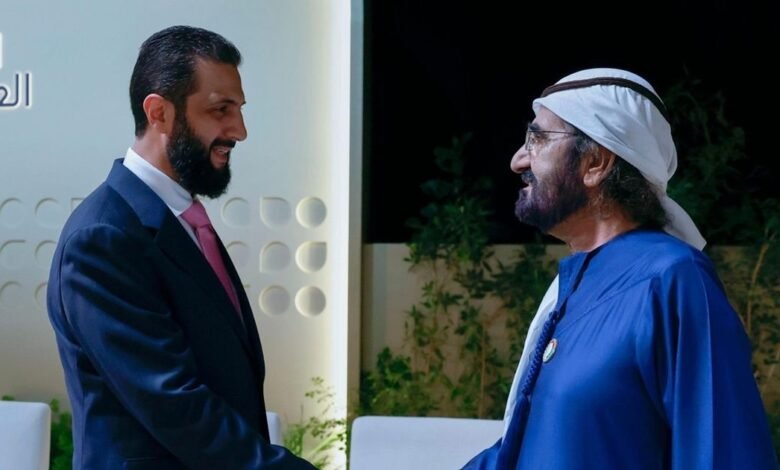
Sheikh Mohammed bin Rashid Al Maktum, Vice President and Prime Minister of the United Arab Emirates, received Syrian President Ahmed al-Sharaa in Dubai on Tuesday. The meeting took place on the sidelines of the Arab Media Summit, where the Syrian leader was participating as a guest. During the encounter, Sheikh Mohammed bin Rashid emphasized that the bilateral relationship is founded upon mutual affection, friendship, brotherhood, and respect.
A Message of Hope and Reconstruction
Following the discussions, Sheikh Mohammed bin Rashid shared images from the meeting on his X account, articulating a clear vision for the future of UAE-Syria relations. He stated that the UAE rejoices at Syria’s return to the path of development. The Emirati leadership expressed strong optimism regarding Syria’s potential to regain its civilizational status on the global stage, highlighting the nation’s deserving place in international affairs.
The message underscored a forward-looking perspective, focusing on the enduring bonds between the two peoples. Sheikh Mohammed bin Rashid noted that the UAE views the future of its relationship with Syria through the lens of these fraternal connections. He voiced confidence in the upcoming phase, anticipating significant progress in Syria’s developmental trajectory and the strengthening of deep, brotherly ties between the citizens of both friendly nations.
Diplomatic Context and Regional Dynamics
This high-level engagement marks a significant moment in diplomatic interactions, occurring within the framework of regional media forums. The presence of the Syrian President at the summit provided a platform for direct dialogue with key regional figures. The reception in Dubai signals an intent to normalize and deepen political and economic cooperation, moving beyond historical complexities toward a pragmatic focus on reconstruction and stability.
The emphasis on “civilizational status” reflects a broader narrative aimed at reintegrating Syria into the regional fold. By framing the relationship around brotherhood and shared heritage, the UAE positions itself as a supportive partner in Syria’s recovery efforts. The visual documentation of the meeting serves to reinforce the public commitment to this renewed partnership, aligning diplomatic rhetoric with tangible political gestures.
As Syria navigates a complex post-conflict landscape, such engagements are critical for establishing new frameworks of interaction. The expressions of optimism from senior UAE leadership suggest a willingness to engage constructively, provided there is a clear commitment to development and regional harmony. This approach aligns with the UAE’s broader foreign policy strategy, which often prioritizes economic integration and stability in neighboring regions.
The meeting concludes with a shared understanding that the path forward requires sustained effort and mutual trust. Both parties appear committed to leveraging their respective strengths to foster an environment conducive to growth and cultural exchange. The outcome of this dialogue may set the tone for future initiatives, potentially opening doors for increased trade, investment, and collaborative projects that benefit both populations.