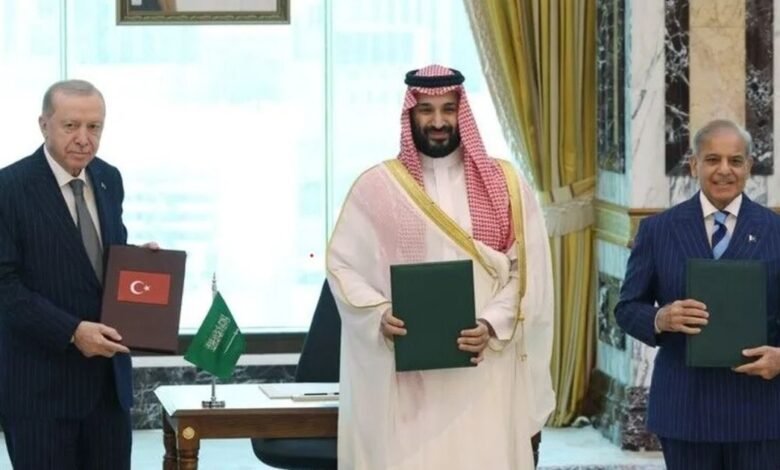
Foreign ministers from Saudi Arabia, Turkey, and Pakistan held meetings in New York on Friday to explore mechanisms for activating the Mecca Agreement for joint defense. The discussions took place against a backdrop of intensified Houthi attacks on Saudi infrastructure and ongoing diplomatic efforts by Iran to distance itself from the actions of its Yemeni allies.
Diplomatic Coordination and Defense Preparations
Saudi Foreign Minister Prince Faisal bin Farhan met with his Turkish counterpart Hakan Fidan and Pakistani Foreign Minister Muhammad Ishaq Dar at the Saudi delegation’s permanent mission to the United Nations. According to the Saudi Press Agency (SPA), the ministers reviewed progress regarding the establishment of the agreement’s general secretariat, committees, and working groups. They also discussed arrangements for an urgent meeting of the three nations’ chiefs of staff to coordinate support for Saudi Arabia under the terms of the Mecca Agreement, which stipulates that an attack on one party is considered an attack on all.
In a joint statement, the ministers strongly condemned recent attacks targeting Mecca and civilian and economic facilities within the Kingdom. They praised the capabilities of the Saudi armed forces to defend national security and affirmed Riyadh’s right to take necessary defensive measures under Article 51 of the UN Charter. The ministers emphasized the importance of international law, good neighborliness, mutual respect for sovereignty, and the freedom of maritime navigation.
Houthi Escalation and Regional Tensions
The diplomatic push comes as Houthi forces have significantly escalated their operations, launching numerous missiles and drones at Saudi targets. Saudi authorities confirmed intercepting six ballistic missiles recently, while Houthi media claimed responsibility for dozens of strikes. These attacks have disrupted oil flows from the Kingdom, the world’s largest energy exporter, and prompted air raid warnings for cities including Mecca, Jeddah, and Yanbu.
In response to the severity of the threat, Saudi Arabia’s Grand Mufti, Sheikh Saleh bin Fauzan Al-Fauzan, issued a rare religious decree urging citizens to prepare for jihad and defend the nation against the Houthi group, citing Quranic verses and prophetic traditions.
Iran’s Diplomatic Maneuvers
Simultaneously, Iranian President Masoud Pezeshkian sought to clarify Tehran’s stance during an interview with Fox News and a speech at the UN General Assembly. Pezeshkian stated that the Houthis are responsible for their own actions and denied direct Iranian involvement. However, Iranian Foreign Minister Abbas Araghchi revealed that Tehran had submitted a proposal to the US via mediators, suggesting a ceasefire across all fronts, including Lebanon, within seven days. In exchange, Iran requested the lifting of port blockades, release of frozen assets, and cancellation of oil sanctions, promising to reopen the Strait of Hormuz on the final day.
This diplomatic activity coincides with a temporary halt in direct combat between the US and Iran. Meanwhile, the US has expanded secondary sanctions, banning Iranian airlines from entering neighboring countries like the UAE and Oman, aiming to deepen Iran’s economic isolation amid the broader conflict initiated by US-Israeli operations in February.