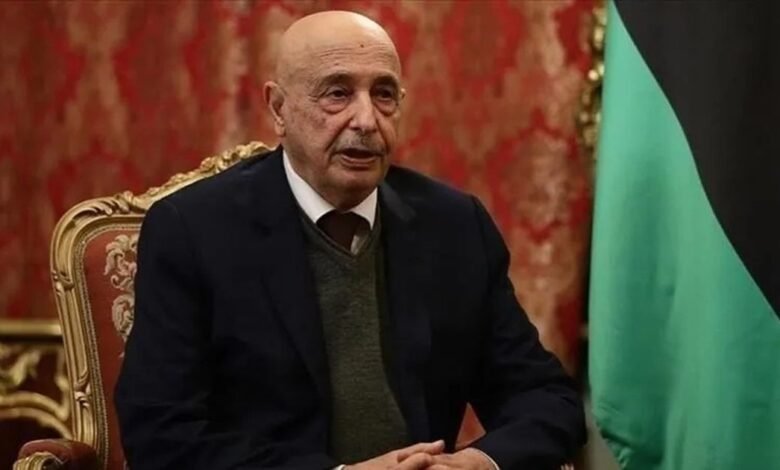
The removal of Aguila Saleh from his position as Speaker of the House of Representatives represents a decisive break from previous political norms in Libya. His loss of power was not the result of a democratic rotation or competitive electoral process among parliamentary factions, but rather a calculated maneuver that underscores evolving dynamics within the country’s political sphere. For over twelve years, Saleh maintained his grip on the legislative helm through a combination of local support and external backing, contrasting with the frequent leadership changes seen in the Higher Council of State, which has been led by three different presidents: Abdulrahman Souehli, Khaled Al-Mishri, and Mohamed Takkala.
Saleh’s longevity was built on three primary pillars: tribal influence, military and security backing, and foreign support. As a member of the Obeidat tribe, the largest in eastern Libya, he leveraged his tribal weight to secure loyalty from the army and its commander, Khalifa Haftar, who has effectively controlled the east and south since 2017. Additionally, Saleh cultivated a close political alliance with Egypt, becoming Cairo’s key partner in the region. However, this triad of support has begun to fracture due to shifting power structures within the Haftar family and realignments in regional diplomacy.
A critical factor in Saleh’s downfall is the emerging rivalry among Khalifa Haftar’s sons. While Khalifa Haftar senior relied heavily on Egyptian support during the 2014–2017 Benghazi war and the 2019 offensive on Tripoli, his fourth son, Sadiq Haftar, has moved away from this alignment. Sadiq has grown closer to Ankara and is pushing for a political and military consolidation plan known as the “Pauls Plan,” aimed at elevating his status to President of the Presidential Council and Commander-in-Chief. This initiative faces opposition from Cairo and other siblings, including third son Khalid Haftar and second son Belqasim Haftar, who have expressed reservations about the plan’s implications.
Saleh had aligned himself with the brothers opposing Sadiq’s ambitions, making him a casualty of this intra-family conflict. His dismissal serves as the first major test for the Pauls Plan, demonstrating the willingness of its proponents to remove obstacles regardless of their political stature. With Saleh out of the way, the path appears clear for the ratification of the 4+4 agreement and its constitutional inclusion by the House of Representatives. Sadiq Haftar is now positioned to consolidate dominance over his siblings, especially if Belqasim retreats from his previous stance.
The repercussions are expected to extend beyond the east. The western region, which strongly opposes the Pauls Plan, may witness significant political and security developments in the coming weeks as stakeholders attempt to counter or accommodate the new reality. The shift also reflects broader regional changes, including the weakening of the Gulf-Egypt alliance and Turkey’s growing influence, potentially bolstered by diplomatic support from former US President Donald Trump. Saleh’s removal thus signals not just a personnel change, but a fundamental restructuring of power in Libya.