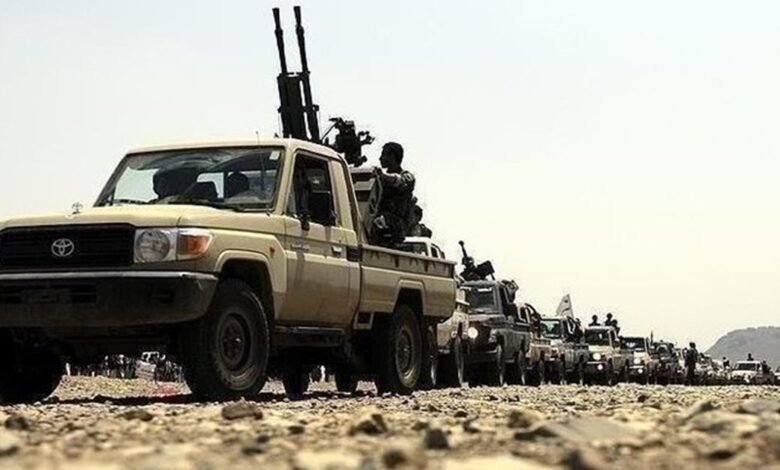
The Yemeni government army announced on Monday that it had regained control of several areas in southern Taiz province. This development follows intense battles fought between government forces and militants from the Houthi movement. In a statement, the military confirmed that its troops stormed and recovered the locations of Nobah, Thib, and Tabat Mubarak within the Al-Aqroud front.
Simultaneously, government-affiliated media outlets reported casualties resulting from a separate Houthi missile attack targeting the Al-Saqiya Health Center in the Al-Mudharibah wa Al-Arhab district of Lahj province. The state Saba news agency stated that the strike resulted in the death and injury of 20 civilians, without providing further details on the specific nature of the injuries or the identities of the victims.
The Houthi movement did not immediately comment on either the territorial losses in Taiz or the civilian casualties in Lahj. Lahj holds significant strategic importance as the land gateway to Aden, the interim capital. It surrounds the city from the north and west, serving as the first line of defense and a vital artery connecting Aden to other governorates. Additionally, Lahj borders Taiz, Al-Dhalea, Abyan, and Al-Bayda, with some districts near the international shipping lane of the Bab al-Mandab Strait and the Gulf of Aden.
Fighting has been recurring for weeks in the Al-Mudharibah district of Lahj without a decisive outcome for either side. Government forces currently control most of Lahj, while Houthis retain positions in parts of Al-Mudharibah, Al-Qubaytah, and Al-Muqatirah, near the border with Taiz.
This escalation marks a break in the relative calm that had persisted since April 2022. Since July of last year, renewed military confrontations have led to thousands of deaths and injuries, alongside the displacement of more than a quarter million people, according to United Nations reports. On October 5, 2026, the military operation “Fajr al-Yemen” (Yemen Dawn) began. Rashad Al-Alimi, Chairman of the Presidential Leadership Council, stated that the operation aims to restore state institutions and retake the capital, Sanaa, from Houthi control.
The conflict in Yemen began in September 2014 when Houthi forces seized Sanaa and several northern provinces. This was followed by an Arab coalition intervention led by Saudi Arabia in March 2015 to support the internationally recognized government. Currently, the Houthis control most of the northern and western governorates, including Sanaa, Saada, Amran, Dhamar, Hajjah, Al-Hudaydah, Ibb, Al-Mahwit, and Raymah, along with partial control over Hajjah, Al-Bayda, Marib, Al-Jawf, Al-Dhalea, and Taiz. Government forces and their allies hold the interim capital Aden, as well as the governorates of Al-Mahrah, Hadramaut, Shabwa, Abyan, and most of Lahj and Al-Dhalea, alongside parts of Taiz, Marib, Al-Jawf, Hajjah, and Saada.