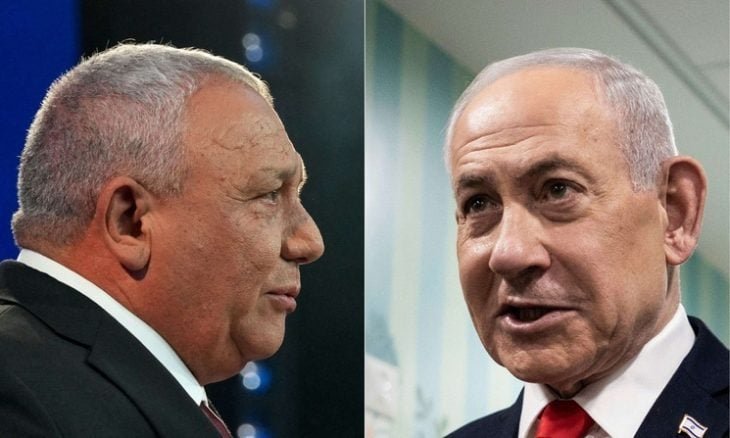
Prime Minister Benjamin Netanyahu appears unmoved by President Donald Trump’s recent hints regarding the conclusion of hostilities with Iran. Despite Trump’s assertion that the conflict has “already ended” and that resuming it is a “very distant scenario,” tensions within the Israeli leadership are escalating. These frictions were highlighted yesterday through exchanges between Netanyahu and rivals in the Change and Democracy bloc, reflecting deep concerns about the possibility of renewed escalation in the Gulf region.
Gadi Eisenkot, head of the Yesh Atid party who was tasked this week with forming a new government, sent an exceptional message to Netanyahu yesterday evening. In his communication, Eisenkot emphasized the need for national responsibility during this sensitive phase. He urged the Prime Minister to exercise caution and self-restraint when making dangerous decisions that could be postponed until a new government wins the confidence of the Knesset. Eisenkot warned against betraying public trust in state institutions and decision-making processes, stating that activating security forces without an immediate and direct threat could have severe consequences for Israeli democracy. He cautioned against placing heads of the security establishment in a position of constitutional opposition.
The Prime Minister’s office responded sharply, declaring that all decisions were made for purely security reasons and in full coordination with the security establishment. It labeled Eisenkot’s message as an irresponsible step that sows fear and division rather than acting responsibly. Subsequently, Eisenkot addressed another letter to the State Attorney Gali Baharav-Miara, requesting her intervention to guide Netanyahu on the obligation to provide regular security reports to him, particularly given the absence of an opposition leader and his current role in government formation.
The intensity of Eisenkot’s statements reflects behind-the-scenes debates and the intensifying political struggle in the Knesset. The Change and Democracy alliance appointed Avigdor Lieberman, head of the Yisrael Beiteinu party, as chairman of the Foreign Affairs and Security Committee. This move aims to strengthen parliamentary oversight over Netanyahu’s actions vis-à-vis the security establishment, especially since the Security Cabinet has not met for a long time. Lieberman announced his intention to summon Shin Bet chief David Zini and Police Inspector General Dani Levi to testify before the committee regarding allegations that investigations into ballot tampering in Arab villages were orchestrated by the Prime Minister’s circle to invalidate election results.
Underlying these political maneuvers is the issue of Iran. The Likud party is attempting to delay the committee meetings, at least until Monday. Knesset Speaker Amir Ohana and Coalition Chairman Ofer Keser threatened to postpone procedural votes, leading the opposition to wait until Lieberman’s appointment is approved. Without a chairman, the committee lacks real authority.
Eisenkot’s latest move follows his appeal to Netanyahu in late October, immediately after the elections, to support Chief of Staff Eyal Zamir. Prior to the elections, Zamir and several senior officers opposed Netanyahu’s attempt to obtain authorization from Trump for a joint attack on Iran or to reignite the war through provocation. Zamir had warned the US administration that renewed war in the Gulf could delay Israeli elections. Trump subsequently decided to prevent Netanyahu from launching an attack before the Knesset elections, postponing the decision until after the midterm congressional elections held last week. Following the Republican Party’s defeat and the Democrats’ gain of control over both chambers of Congress, Trump appears hesitant to resume the war. He reportedly prefers continuing negotiations with Iran mediated by Qatar and increasing naval blockades and economic pressure on Tehran. The clear impression is that Netanyahu seeks to reignite the conflict, either proactively or through tactics designed to draw Iran back into the fray. The military is concerned that such moves could disrupt Israel’s proper political process. As demonstrated in his sharp speech in the Knesset two days ago, Netanyahu seems to be fighting by all means to remain in power. The Change and Democracy bloc must ensure that the Prime Minister does not lead the state into new, dangerous military adventures as part of his desperate efforts to stay in office.